
TPM Consultant

Organizations have dedicated maintenance and support departments, and they are primarily responsible for ensuring that all equipment owned and managed by the organization is at its peak operating capacity.

TPM in business brings about a paradigm shift in how equipment is handled and maintained to improve this.

What exactly is TPM in Lean Six Sigma?

  • Total Productive Maintenance (TPM) is a product maintenance strategy that advocates that everyone should participate in maintenance beyond just the maintenance department. TPM strategy uses all employees’ skill sets and aims to integrate maintenance tasks into an organization’s daily operations.
     
  • In other words, TPM lean manufacturing is a holistic approach to equipment maintenance that strives to achieve perfect production with the following:
    • ZERO Breakdowns
    • No Small Stops or Slow Running versus rated capacity
    • ZERO Defects
    • ZERO Accidents

How will ARROWHEAD TPM Consultant Help Your Organization’s Management?

Frequently Asked Question

What is Total Productive Maintenance (TPM)?

a. Total Productive Maintenance (TPM) is a comprehensive approach to facility maintenance that aims to achieve perfect production and eliminate unplanned breakdowns

  1. No Breakdowns
  2. No Small Stops or Slow Running
  3. No Defects
  4. No Accidents

By integrating proactive and preventive maintenance strategies, TPM seeks to maximize equipment effectiveness, reduce downtime, and enhance overall productivity.

a. Adapting TPM principles for service sectors involves broadening the concept of equipment to include all critical resources, focusing on empowering employees, aligning with Strategic Planning, investing in training, and measuring impact through KPIs to improve service delivery and operational efficiency.

b. In service-oriented sectors, the concept of “equipment” in TPM can be broadened to include any resource critical to service delivery, such as information technology systems, human resources, and processes. The goal remains to maximize the effectiveness of these resources. For instance, in a consulting firm, ensuring that consultants have uninterrupted access to research databases and collaboration tools directly impacts the quality and speed of the service provided. Similarly, in healthcare, the efficiency of patient record systems and the availability of medical equipment are crucial for delivering high-quality care.

a. The time it takes to implement TPM (Total Productive Maintenance) varies depending on the company.

b. However, it is estimated that most companies can realize a 20-25 percent increase in equipment efficiency rates within two years of adopting TPM.

c. TPM implementation generally involves five steps: identifying a pilot area, restoring equipment to prime operating condition, measuring OEE, addressing and reducing major losses, and implementing planned maintenance. Once this is proven, expand the area of execution across your entire plant or in service sectors your end-to-end business process.

a. Yes. We have two TPM workshop models.

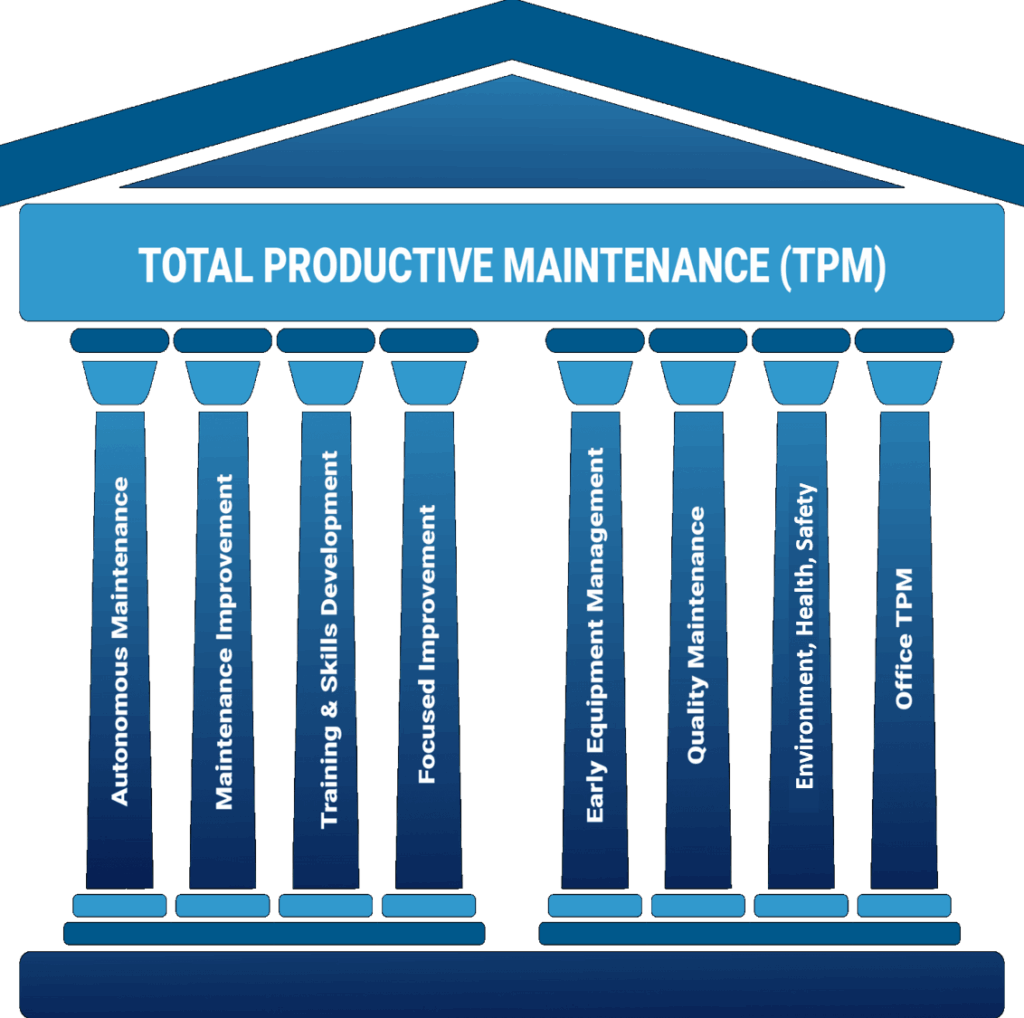
b. Basic: 1 day (8 hours) where we introduce TPM concepts and reveal all 8 pillars of TPM and their significance to overall productivity. Suitable for shop floor, machine operators, maintenance staff.

c. Detailed: 4 days (32 hours total) where all 8 pillars of TPM are explained in detail along with roadmap of how to implement. As part of Pillar Kobetsu Kaizen, we help identify all TPm related kaizen events that can make drastic improvement in reducing unplanned breakdown (of machines or processes).

d. Certificate of participation to all attendees is awarded.

Request a callback