

Lean manufacturing is a structured methodology focused on eliminating waste, maximizing customer value, and driving continuous improvement across the supply chain by applying proven lean principles, tools, and techniques. It centers on mapping the value stream from order entry to dispatch, distinguishing value-added from non-value-added activities, identifying push or pull flows between work centers, quantifying the VA:NVA ratio, and designing an ideal future state to dramatically improve that ratio. In every value stream mapping exercise, ARROWHEAD begins by pinpointing opportunities to simplify, optimize, eliminate, or improve repeatable processes—especially those involving multiple handoffs—then leverages its Black Belts to identify targeted kaizen opportunities that deliver measurable reductions in non-value-added time and sustainable operational gains.
We first identify main reason for creating the process map by listing the names of the processes and the resulting input/output.
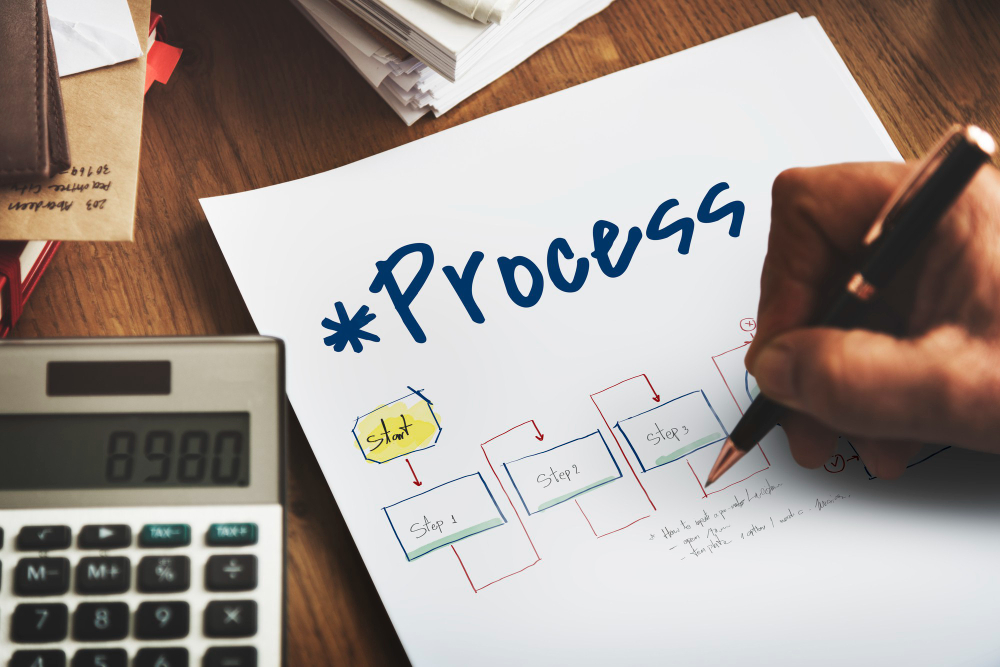
We ensure purpose must be clearly defined, i.e., what parameters or conditions will satisfy the request by identifying the process steps, inspection/test, rework, and loss points.
• Controllable inputs: The input variables in the hands of the team can be controlled or altered.
• Noise inputs: Inputs that affect outputs and are not controllable or too expensive to control
• Standard operating procedure: Inputs defined by operating procedures, e.g., Cleaning, Budget, and Maintenance

Documenting the process map involves putting the steps and information gathered above into a coherent, easy-to-understand diagram. Based on systems and roles, proper scheduling of people involved, tasks involved, and estimated time.

Once the process map is complete, we gather feedback from those who will implement the process and other stakeholders who may not directly participate in the workflow but are indirectly interested in it. This feedback aims to ensure that the process map is clear and complete.

We help to assign tasks and responsibilities once the work is done.

We help identify all areas which can be directly impacted using a kaizen approach. For improvements that cannot be solved by Kaizen, we build project charters with defined G&Os.

a. Process mapping is a visual representation of a process that shows the steps, decision points, inputs, and outputs involved in a workflow.
b. Good process maps help identify areas for improvement, communicate processes, and are used to train new employees.
a. In most cases, a process map will also detail the resources — human and material — involved throughout the process.
b. The goal of creating a process map is to improve the efficiency and effectiveness of a process by visually showing the steps and decision points involved in a particular workflow.
c. Mapping a process involves team members from different functions, hence it is an effective team building exercise that helps build consensus and thereby identify opportunities for improvement.
a. Process mapping can be beneficial for any organization with complex processes.
b. Every industry regardless of it being part of services or manfacuring or assembly can benefit from process mapping.
This is dependent on the process at hand. It could take a few hours to several days depending on number of functional work centres, quality parameters and procedures, testing, complexity of equipment or skill of manpower etc.
a. Yes, absolutely!
b. ARROWHEAD provides consultants that can update all your existing process maps, build new ones, document all process maps.
c. Once this is completed, we will train your employees on any changes from existing processes and/or help launch new processes with training sessions.
By reducing Lean waste, you can remove all non-value added activities thereby improving speed of reaching your customer at better margin and by improving consistency you are able to meet customer demand in terms of quality expected.
© Copyright 2023 – Arrowhead | Designed by Bricks Media